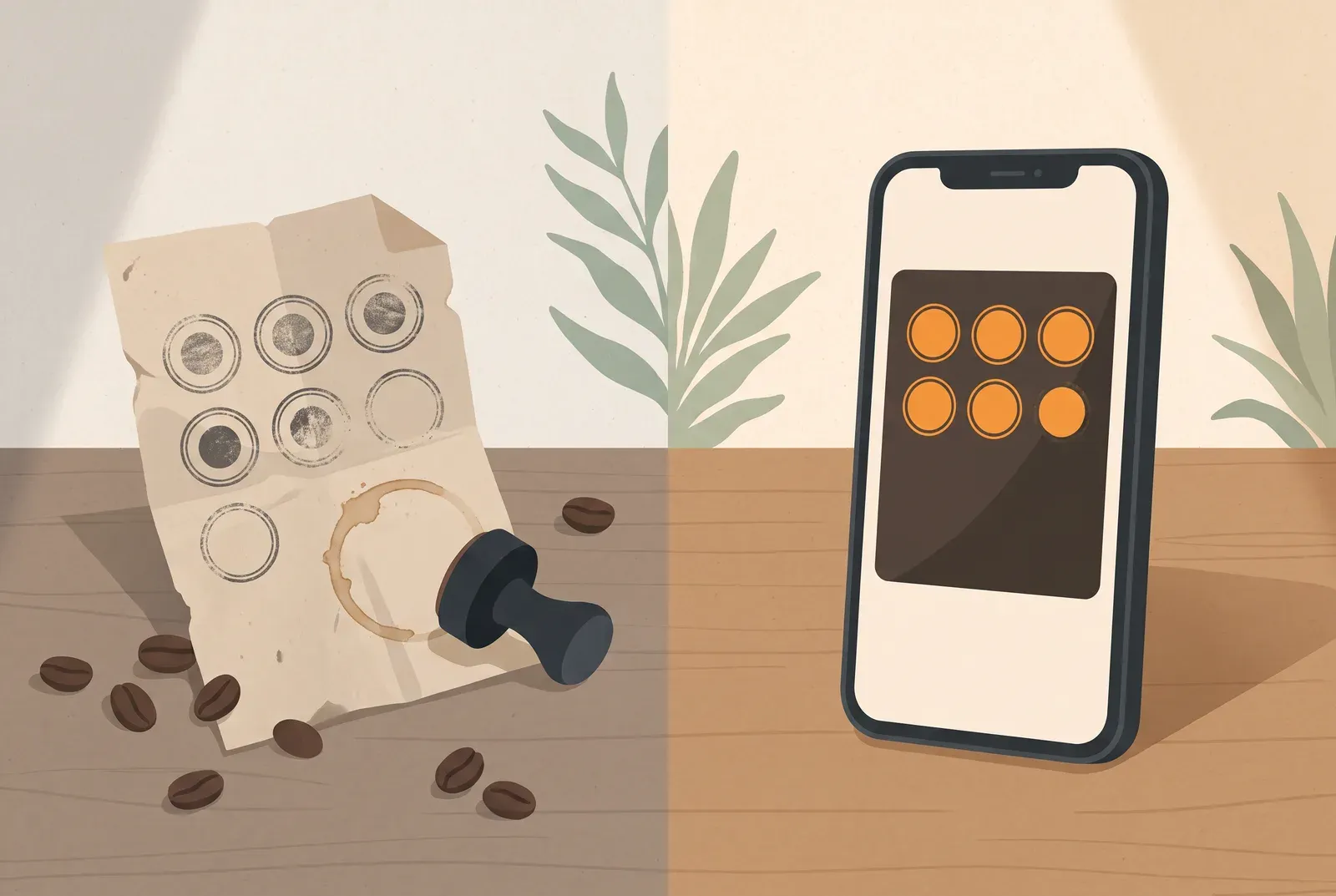
The paper stamp card is a classic. It has lived next to every till for decades, and honestly, it works. Otherwise it wouldn’t still be around. Still, it’s worth taking a sober look at what it actually costs you, and what a digital card does differently. This isn’t a sales pitch. It’s an honest comparison.
What paper does genuinely well
Let’s start fair. Paper has real strengths.
It works for everyone. No app, no smartphone, no explanation. Even the regular who keeps her phone firmly in her pocket can use a paper card.
It’s tangible. A stamp landing on the card with a satisfying thunk has a certain something. Some customers love exactly that.
It’s instant. Get cards printed, buy a stamp, done. There’s no technology to set up and nothing to learn.
If your customers are mostly people without smartphones, paper may well remain the right choice for you. We’d rather tell you that straight than talk you into something.
What paper actually costs you
The card itself costs a few cents. The real costs sit elsewhere.
Printing, reordering, restocking. Every batch needs to be designed, printed and paid for. When cards run out or your offer changes, the cycle starts again.
The card is never there when it’s needed. Left in the other wallet, lost, or put through the washing machine. Every lost card is an interrupted customer relationship. The collected stamps are gone, and with them, usually, the motivation.
Stamps are easy to fake. The standard motif stamps cost a few euros online. You’ll rarely notice, but you end up giving rewards to people who didn’t earn them.
You learn nothing. How many cards are out there? How many get completed? Do people come on Tuesdays or Saturdays? Paper won’t tell you. You hand out rewards without knowing whether the programme even works.
What a digital stamp card does differently
With Treubar, the stamp card doesn’t live in a wallet made of leather. It lives in Apple Wallet or Google Wallet, right next to boarding passes and concert tickets. The key point: your customers install nothing. They scan your QR code at the counter once with their camera, and the card is in their wallet. That works on iPhone and, via Google Wallet, on Android phones too.
That changes a few things fundamentally.
The card is always there. It’s wherever the phone is, which is to say, practically always. Losing, forgetting and washing are off the table. And after every stamp it updates itself on the lock screen.
Stamping is a scan. Your team scans the customer’s pass in the app in one motion, about as quick as a rubber stamp, except it can’t be forged. Built-in protection stops anyone stamping themselves five times in a row.
The card is alive. After every stamp the pass updates itself, right on the customer’s lock screen. When the card is full, she sees it immediately, and you can redeem the reward on the next visit, or she can save it for later.
You can see what’s happening. How many cards are active, how often people stamp, who comes back: it’s in your dashboard instead of your gut feeling.
The honest limits of going digital
Fair is fair here too. Digital isn’t automatically better for every business.
Your customers need a smartphone. For most people that’s a non-issue. But if your regulars largely don’t carry one, you won’t reach them this way.
The first scan sometimes needs one sentence. “Just scan it with your camera, the card goes straight into your wallet.” That’s all it takes, but you’ll be saying it a few times in the first weeks.
It’s a subscription instead of a print bill. Treubar has a free plan to try things out; if you need more, you pay monthly. In return, printing costs and reorders disappear for good.
The side-by-side
| Paper card | Digital card (wallet) | |
|---|---|---|
| Upfront | Printing costs per batch | Free to start, then subscription |
| Always on hand | Only if remembered | Yes, it’s in the phone |
| Loss | Card and stamps gone | Can’t be lost |
| Fraud protection | Barely any | Scan with built-in protection |
| Changes | Reprint a new batch | Any time, in the app |
| Insight | None | Active cards, stamps, repeat visits |
| Customer requirement | None | Smartphone with a wallet |
So what does that mean for you?
If you’re happy with your paper card and your customers love it: keep it. But if the lost cards, the printing bills or the guesswork about your regulars bother you, the digital stamp card is the logical next step, and your customers never have to install a single thing. The step-by-step guide shows exactly how the switch works; the features page covers what else the app can do.
Treubar is available for your iPhone on the App Store. The free plan is enough to build your first card and try it with real customers. Then you decide for yourself whether it feels right for your shop. And if you’re thinking more broadly about keeping regulars, start with the practical loyalty programme guide.