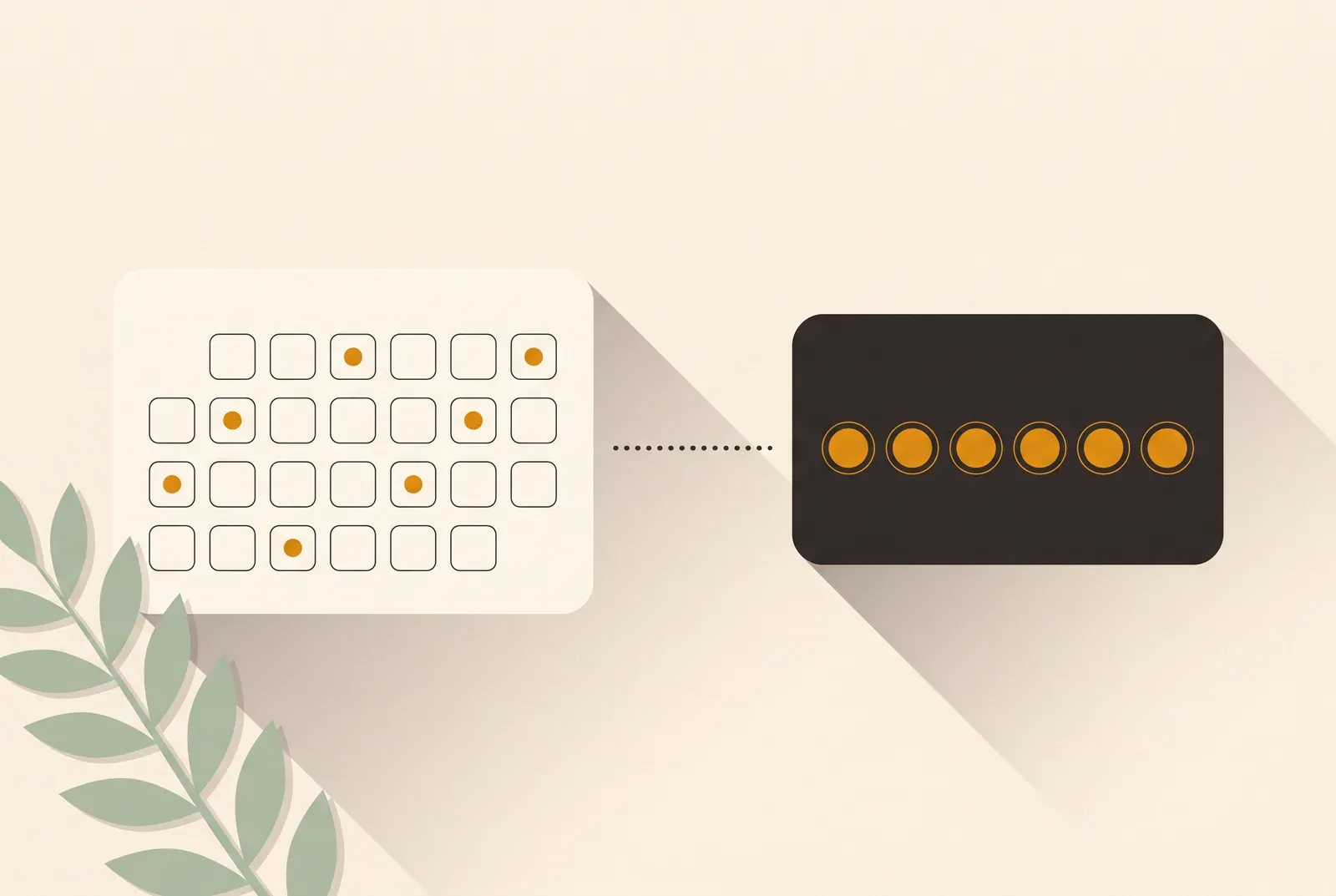
“How many stamps should I put on the card?” is the first question almost every owner asks. Most people just guess. Ten, because ten is a round number. But there’s an honest calculation that gives you the real answer in under a minute. It only needs two ingredients: how often your regulars come in, and how many stamps stand between them and the reward. The rest is multiplication.
The one formula you need
Take your visit frequency, meaning how many times a typical regular stops by per week, and divide your stamp target by it. What comes out is the time to a full card:
Stamp target ÷ visits per week = weeks to the reward.
An example. Say you’ve got 10 stamps and your regulars come in five times a week on average. 10 divided by 5 is two weeks. Just right. If they only come once a month, those same 10 stamps are suddenly ten months away, too far off to keep anyone motivated.
The rule of thumb behind it is simple: a good card fills up in weeks or a few months, never years. Anything that works out to longer than half a year feels unreachable to your guest. They collect the first two or three stamps, then forget about the card. Not out of dissatisfaction, but because the goal never gets any closer. Your job is to keep it in sight.
Cafés: the classic ten
For a café, the math almost solves itself. Someone who’s made your coffee part of their morning routine stops by four or five days a week. With 10 stamps, the card fills up in a good two weeks, fast enough that the guest feels the progress, and priced generously enough that the tenth coffee on the house still pays for itself.
Ten is the ceiling here, not the minimum. If your walk-in crowd only swings by twice a week, eight stamps (or even six) is the smarter call. Coffee margins are forgiving: one free cup costs you little and comes after five paid ones. More on why the tenth coffee on the house pays off is on the café industry page.
Bakeries: high frequency, small reward
Bakeries run on daily habit. Nobody picks up bread rolls once a week. It’s practically every day, which makes this the highest visit frequency of any category here. With 10 stamps for a loaf of their choice, a regular hits the target in under two weeks.
The mistake bakeries tend to make is tying the stamp to a minimum spend (“one stamp from €5”). That forces your early-shift team into little calculations nobody has time for at seven in the morning. One visit, one stamp gets stamped in seconds, even with a queue at the counter. Which reward actually pays off, whether it’s bread, rolls, or a coffee to go, depends on what you sell. But a visit stays a visit either way.
Hair salons: where ten becomes a trap
This is where the math flips, and where most salons get it wrong. A haircut is due every five to six weeks, often less. Take 10 stamps and do the math: at one visit every six weeks, that’s roughly 60 weeks, or well over a year before the reward. Nobody collects toward a goal that far out.
For appointment-based businesses, you need to cut the stamp target drastically. Five or six stamps is realistic: at six visits on a six-week rhythm, the card fills up in about eight months. A rhythm that’s slow by nature, but with a goal that stays within reach. And the reward can afford to be more generous here, since a single visit is worth far more than a cup of coffee. More on the stamp logic for appointment-based businesses is on the industry page for hair salons and barbershops.
Ice cream shops: the season does the math too
Ice cream shops have an ingredient no other category deals with: the clock only runs for half the year. Business is brisk from April to September, then the machine sits idle all winter. Ask for 10 stamps here and the card runs straight into the off-season before it’s full, and never gets there.
That’s why five stamps is the right call for ice cream. An extra scoop as the reward, reachable within a few summer weeks: if a family stops by once a week, the card fills up in about a month, well before the season ends. Short targets suit impulse buys anyway. Nobody at the ice cream counter wants to wait long, in line or for the reward. More on the seasonal logic is on the industry page for ice cream shops.
Gyms: the goal is showing up
At a gym, the member is already paying for their membership. The stamp card isn’t rewarding spend, it’s rewarding showing up. That’s exactly why the target sits higher: 12 stamps, one per check-in. Someone training two or three times a week fills the card in four to six weeks.
That’s by design. The reward, a month’s upgrade for example, is meant to carry people through the first few weeks, which is when most people quit. Every stamp is visible proof that they’re sticking with it. Here the card works less like a discount and more like a motivation anchor. More on the check-in logic is on the industry page for gyms.
The small trick with a head start
There’s a way to make every card feel closer to the goal without changing the math at all. The café field study by Kivetz, Urminsky and Zheng (2006) found that people finish a collector card faster when it starts with a few stamps already given to them, even when the actual remaining effort is identical. A card reading “2 of 12” instead of “0 of 10” asks for the same ten real visits, but it already feels underway. And people don’t like abandoning something they’ve already started.
In practice: instead of handing out an empty 10-stamp card, you can issue a 12-stamp card with the first two already stamped. The effect is honest. You really are giving away two stamps, and it helps guests actually finish the card in the first place. Don’t overdo it. A head start is a nudge, not a standing discount.
Frequently asked questions
How many stamps are right, in general?
There’s no universal number, only the calculation. As a rough map: cafés and bakeries with high frequency sit around 10, ice cream shops around 5 because of the season, hair salons 5 to 6 because of the slow rhythm, and gyms around 12 as a motivation anchor. What matters every time is that the card fills up in weeks or a few months.
What if my regulars come in at very different rates?
Base the math on your regulars, not on one-time visitors. The card is meant to reward the people who come back anyway. They’re the rhythm you should design around. Whoever fills the card fastest is your best guest, and letting them get there quickly isn’t a loss. It’s the whole point.
Can I change the stamp target later?
On paper, that means reprinting everything. Digitally, you just change the stamp count and reward in the app, and nobody needs a new card. That’s exactly why it’s worth starting with a digital stamp card like Treubar: you treat your target as a hypothesis and adjust after a month or two if the numbers say otherwise.
Isn’t the reward too generous if the card fills up fast?
Rarely. Weigh the free item against the visits that came before it: at a café, five paid coffees precede the free one. The reward goes to your most loyal guests, and repeat business is the cheapest revenue there is. If a card ends up too costly, the problem is usually not the reward, but a stamp target set too low.